

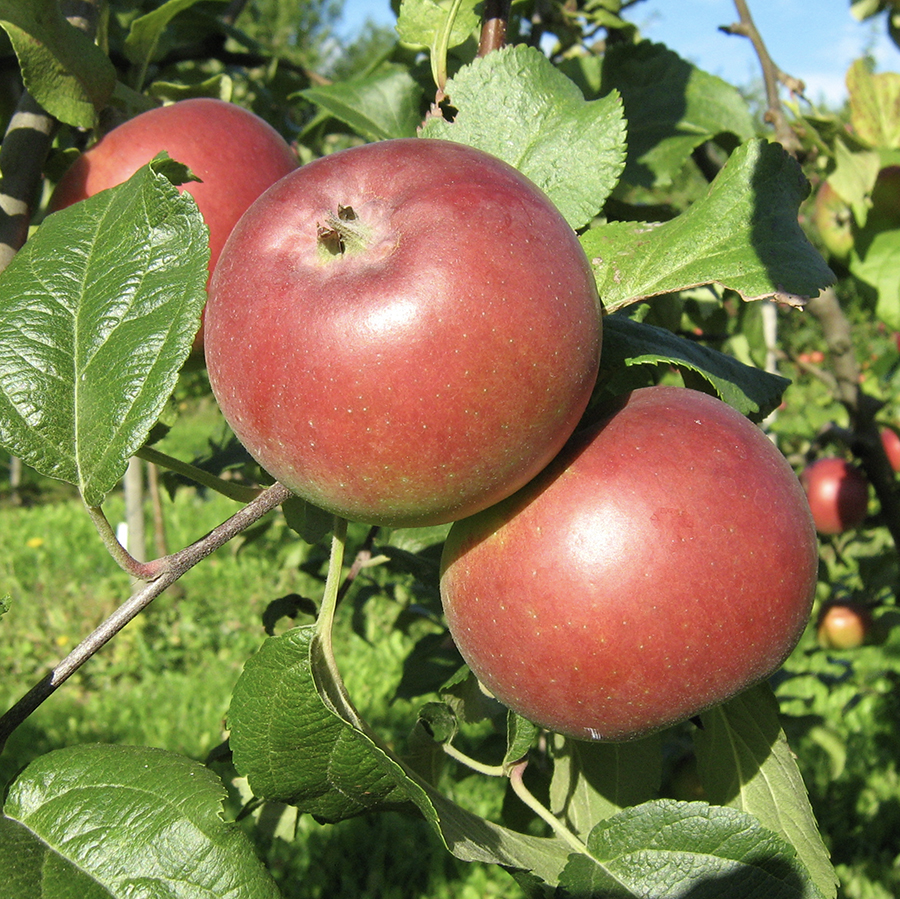
A scab-resistant, winter-hardy and productive winter apple tree. Fruits with very good commercial quality. In trials, it has shown increased resistance to adverse growing conditions.
Early winter - winter variety . Harvested late, in late September - early October, stable on the tree. Can be used as early as November, but stored until January - March. Fruits harvested too late may suffer from lenticel spotting during storage.
Fruits are good-looking, medium or large, round, smooth and even. The bright dark red top color almost completely covers the yellow base color. Thinning of fruit clusters is recommended, otherwise some of the fruits will be small. Fruit peel is firm, flesh is medium firm – 5.4 kg cm-². Fruits are durable in transport. Flesh is white or cream-colored, crisp and juicy, sweet and sour, aromatic. Good or very good rating in tastings. Contains a lot of sugar – up to 16.8 °Brix soluble dry matter, but also quite a lot – up to 1.56% acids (sugar-acid ratio medium, 10.8). Overall, the taste is harmonious, changes little during storage and is stable over the years.
The tree is medium to large in size, grows strongly and branches well in the nursery, forms wide branching angles. Later on the short rootstock Pure 1, the base of the branches may become bare, but this was not observed on the slightly stronger rootstock B476. The crown is much better than the parent variety 'Forele'. In the first couple of years, the yields are lower than 'Auksim', but soon it catches up in yield.
Blooms medium early, flowers large.
Resistant to 5 races of scab (gene Vf/Rvi6), although in recent years, due to the appearance of new races of scab in Latvia, minor damage to the leaves has been observed. Also resistant to powdery mildew, and no canker has been observed so far.
Winter hardiness in Dobele and Pūre is very good.